
Data for: Can Large Language Models (or Humans) Disentangle Text Features
Description: Repository containing (1) raw text, (2) human-coded sentiment portions of text, and (3) human-revised text after an attempt to remove all sentiment information.
[Dataverse] [Hugging Face] [Article]
–
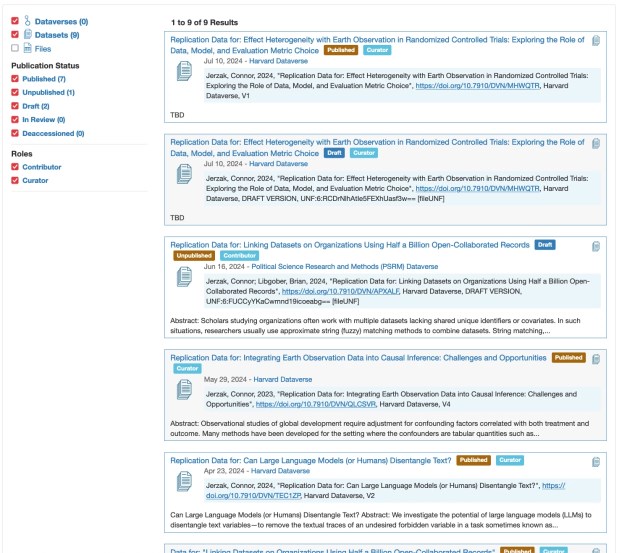
Data for: Linking Datasets on Organizations Using Half a Billion Open-Collaborated Records
Description: Repository contains millions of training examples of positive and negative organizational name matches derived from the LinkedIn corpus. It also contains two distinct network representations of relationships between names on the network. Data are useful for fine-tuning LLMs or building large-scale organizational name-match models. We also include data on four merge tasks where the merge variable has been human-coded; these tasks revolve around the role of money in politics.
[Dataverse] [Hugging Face] [Article]
–
Data for: Multiplication in Multimodal LLMs: Computation with Text, Image, and Audio Inputs
Description: Repository contains a 10,000-example multimodal multiplication benchmark with aligned text, image, and audio renderings of the same arithmetic problems. It also includes a 1,000-item heuristic-disagreement probe set and a 30-item adversarial trap set designed to diagnose strategy-specific failures in arithmetic reasoning. Each example includes exact products along with metadata on digit structure, nonzero counts, complexity, and train/validation/test splits. Data are useful for benchmarking, probing, or fine-tuning multimodal LLMs on arithmetic computation across modalities.
[Hugging Face] [Article]
–
Data for: Temporal Neighborhood-Level Material Wealth Maps of Africa (1990–2019)
Description: Repository contains neighborhood-level material wealth estimates for populated areas across Africa from 1990 to 2019, stored as a multiband GeoTIFF with 10 three-year time windows. Each band reports International Wealth Index (IWI) estimates at approximately 6.72 km resolution, generated from satellite imagery and a deep-learning model trained on Demographic and Health Surveys data. The repository also includes province-level tabular summaries of changes in average wealth between 1990–1992 and 2017–2019.
[Hugging Face] [Article] [AI & Global Development Lab]
–
Data for: Platonic Representations for Poverty Mapping: Unified Vision-Language Codes or Agent-Induced Novelty?
Description: Repository contains more than 60,000 geolocated DHS clusters across Africa paired with high-resolution Landsat satellite images, textual descriptions generated by LLMs conditioned on location and year, and textual data retrieved by an AI search agent from web sources, labeled with International Wealth Index (IWI) scores. Data are useful for training multimodal models for poverty prediction, analyzing representational convergence between vision and language modalities, and benchmarking generalization in socio-economic AI. The dataset enables investigations into the Platonic Representation Hypothesis and agent-induced novelty in development contexts.
[Hugging Face] [Article]
–
Data for: The Composition of Descriptive Representation
Description: Repository contains information on the gender, ethnicity, religion, and language of political leaders across the globe. Other leader features include age, educational attainment, and birthplace. Merged population-level statistics also provided for the different group types.
[Dataverse (Full Replication)] [Article]
[Dataverse (Distilled)] [Hugging Face (Distilled)]
–
Data for: Football Fandom in Egypt
Description: Repository containing cleaned full‑text articles (publication_date, URL, text) on Egypt’s “Ultras” football fan groups scraped from Egypt Independent (2009–2020), for analysis of fan culture, sports media, and political mobilization.
[Dataverse] [Hugging Face] [Article]
–
Data for: Image-based Treatment-effect Heterogeneity
Description: Repository contains experimental data for an anti-poverty intervention in Uganda, along with geo-referenced satellite imagery for each experimental unit.
[Dataverse] [Hugging Face] [Article]
–
Data for: Integrating Earth Observation Data into Causal Inference: Challenges and Opportunities
Description: Repository contains observational data for aid interventions in Nigeria, along with geo-referenced satellite imagery for each observational unit.
[Dataverse] [Hugging Face] [Preprint]
–
Data for: Benchmarking Debiasing Methods for LLM-based Parameter Estimates
Description: Repository contains texts from four corpora (Bias in Biographies, Misinfo-general, Amazon reviews, Germeval18) annotated by DistilBERT + logistic regression, Phi-4, DeepSeek v3, and Claude 3.7 Sonnet. It also includes coefficients from logistic models trained in two experiments evaluating debiasing methods (DSL, PPI) for LLM-based parameter estimates. Data are useful for benchmarking and improving debiasing techniques in LLMs.
[Hugging Face] [Article]
–
Data for: An Improved Method of Automated Nonparametric Content Analysis for Social Science
Description: Repository contains data for 74 text analysis tasks related to politics and public opinion.
[Dataverse] [Hugging Face] [Article]
–
Data for: A Survey Experiment on Social Issues in the United States (2016 Election Study)
Description: Repository contains individual-level responses to an online survey experiment on crime, welfare, and other social issues conducted Sept 12–Nov 15, 2016, featuring randomized crime-framing treatments, demographic and ideological covariates, a pre-/post-election panel structure, and the full survey instrument.
[Dataverse] [Hugging Face]
–
Data for: The Impact of a Transportation Intervention on Electoral Politics: Evidence from E-ZPass
Description: Repository contains data on a transportation intervention in New Jersey and Pennsylvania, along with changes in housing values, electoral outcomes, and individual-level campaign contribution behavior.
[Dataverse] [Article]
–
Data for: Ultras‑Global – A Dataset of Football Fan Groups Amid Political and Societal Change (1950 – 2025)
Description: The Ultras‑Global dataset compiles comprehensive information on 106 organized football fan groups across 36 countries. Gathered from sources such as Wikipedia, fan directories, news archives and academic literature, it provides temporal coverage from 1950 to 2025, revealing surges during democratization and economic upheaval. Variables include founding and dissolution years, ideological leanings (left‑wing, right‑wing, apolitical), criminal reputation and bans, rivalries, social‑media footprints (over 10 million total followers) and club win rates. The dataset enables analyses of ultras groups as amplifiers of societal tensions or agents of unity, and supports quasi‑experimental designs using close‑match outcomes to study the effects of team success on mobilization
[Hugging Face]
–
Data for: Rerandomization Benchmarks (fastrerandomize)
Description: This replication dataset supports the benchmark and diagnostic analyses in Goldstein, Jerzak, Kamat & Zhu (2025), “fastrerandomize: Fast Rerandomization Using Accelerated Computing”. It contains simulation‑based benchmark results comparing rerandomization across hardware back‑ends (Apple M series, CPU/GPU, NVIDIA GPU , non‑accelerated R and the jumble package) and across problem scales (sample sizes, covariate dimensions, Monte‑Carlo draw budgets and exact vs. approximate linear algebra). Each row records design parameters (n_units, k_covars, maxDraws, treatment effect), performance metrics (runtime for randomization generation and testing) and statistical diagnostics. These data were used to produce runtime figures, compute speedup factors and generate macros for the paper
[Hugging Face] [Article]
–
A Dataset on Propensity Score Matching Papers, 1964-2014
Description: This dataset provides methodological information on a random sample of academic articles involving propensity score matching (PSM).
[Dataverse] [Hugging Face]
–
Planetary Experiments Repository (Geo-located RCTs)
Description: A collection of Randomized Controlled Trials (RCTs) suitable for linking with satellite imagery (Planetary Causal Inference – PCI). Key features include geo-located units (village/block/ward level), defined control/treatment groups, sufficient sample size/spread, and documented design. Includes studies on poverty, cash transfers, voter turnout, and environmental interventions.
[Link]
–
Data Downloads Leaderboard
–
–